Emergency Water Extraction Murray UT: What the Process Looks Like
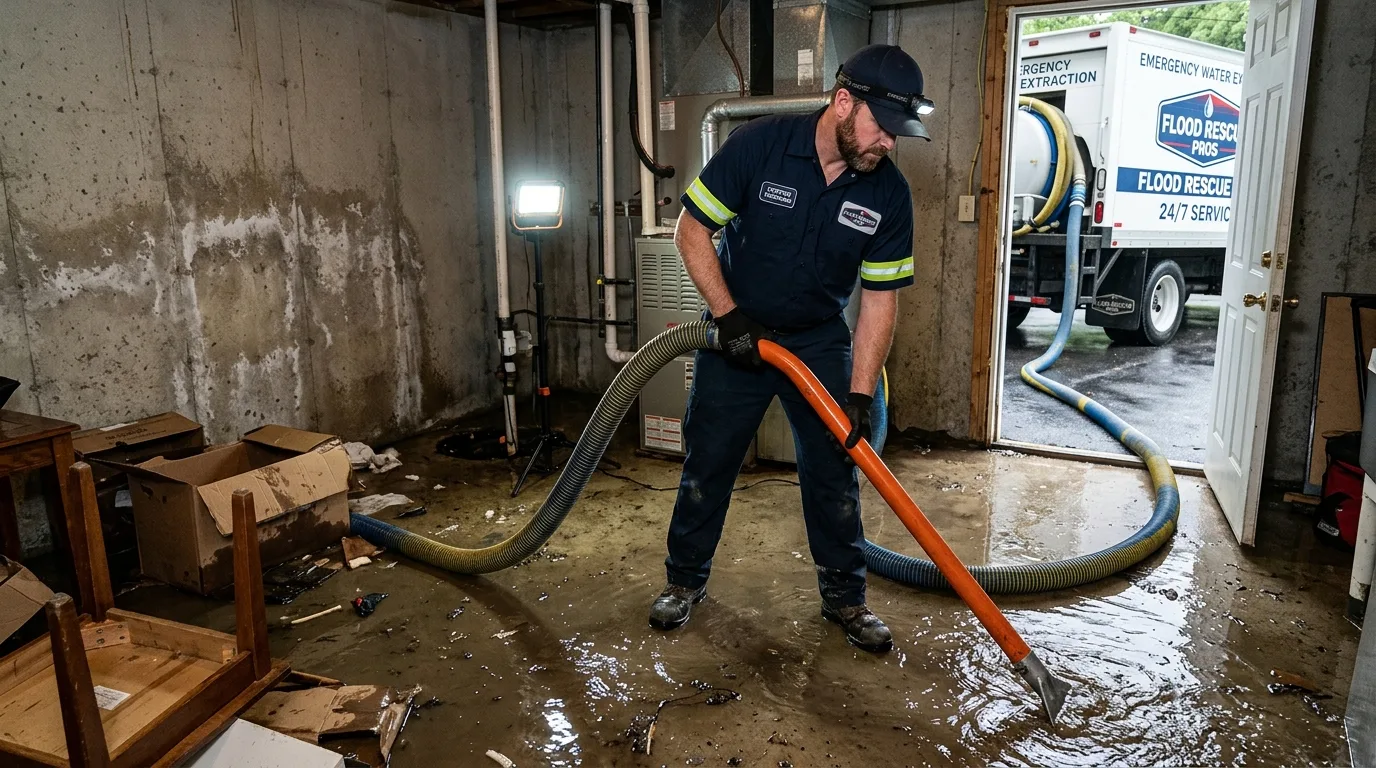
The average residential water heater holds 40 to 50 gallons. A 3/4-inch supply line at normal municipal pressure releases 6 to 8 gallons per minute. By the time many Murray homeowners call for emergency water extraction, tens or hundreds of gallons have already saturated their floors, wicked into walls, and begun working through insulation. Understanding what happens from the moment our team arrives helps you know what to expect, how long extraction takes, and why each step matters. In this post, we walk through the complete process — from dispatch through final drying documentation.
Emergency Water Extraction in Murray — Call Now, 24/7
Murray Water Damage Restoration responds immediately throughout Salt Lake County. Call (877) 698-1311 for dispatch.
Why Emergency Water Extraction Requires Professional Equipment
Consumer wet-vacuums and mops can manage surface water in small areas, but they cannot address the moisture that has penetrated porous materials. Within minutes of water contact, carpets, drywall, insulation, and wood subfloor begin absorbing moisture through capillary action — the same mechanism by which a paper towel draws water upward. By the time surface water is visible and manageable, the materials beneath it have already absorbed significantly more water than the surface pooling suggests.
Truck-mounted extraction units are the standard for emergency water extraction because they generate suction far beyond what any portable unit can produce. These systems pull water from the deep material fibers rather than just the surface, dramatically reducing drying times and limiting the scope of material replacement. Murray Water Damage Restoration uses truck-mounted extraction for all major water loss events throughout Salt Lake County — not portable units that take twice as long and leave twice as much moisture behind.
Step-by-Step: What Happens When Our Team Arrives in Murray
Arrival and safety assessment (15 to 30 minutes): Before extraction equipment enters the building, we conduct a rapid safety assessment: checking for electrical hazards (water near outlets or panels), gas odors, and structural concerns. If any hazards are present, we address them or coordinate with appropriate utilities before proceeding. For Murray homes with below-grade electrical panels — common in older homes throughout the Murray Park neighborhood — this step is particularly important.
Water categorization (10 to 15 minutes): The water category determines the safety protocols and equipment selection. Category 1 (clean water from a supply line) is the most straightforward. Category 2 (gray water from a toilet tank, washing machine, or dishwasher) requires antimicrobial application. Category 3 (black water from sewage backup or outdoor floodwater) requires full PPE and complete removal of all porous materials that cannot be adequately sanitized. Our technicians test and classify the water before extraction begins.
Extraction of standing water (30 to 120 minutes depending on volume): Truck-mounted extraction begins with standing water removal from all accessible surfaces — floors, carpets, and any area where water is pooling. Carpets may be rolled back during extraction to remove water from both carpet fibers and the pad beneath. For Murray basement flooding events, extraction typically focuses on the lowest point first — floor drains, utility areas, and any areas where water is deepest.
Moisture mapping with thermal imaging and meters (30 to 60 minutes): After visible standing water is removed, we conduct a moisture survey of the entire affected area using infrared thermal cameras and calibrated moisture meters. Thermal cameras identify temperature differentials that indicate moisture inside walls and beneath flooring — areas that show no surface evidence of water damage but may be extensively wet inside. This mapping determines the full scope of affected materials and guides drying equipment placement.
Selective demolition if needed (1 to 2 hours): When moisture mapping reveals significant water inside finished wall assemblies — common after pipe bursts inside walls in Murray’s older homes near City Center — selective demolition creates access points for drying equipment. We remove only the material necessary to allow airflow to the wet assembly, minimizing reconstruction scope.
Drying equipment deployment (45 to 60 minutes): Industrial air movers (high-velocity fans) and dehumidifiers are placed according to the calculated drying plan for the specific area. Air movers are positioned to create airflow across wet surfaces. Dehumidifiers are sized for the total volume of the affected space. Equipment placement is adjusted as materials dry throughout the monitoring period.
Daily monitoring and documentation: Technicians visit the property daily to take moisture readings in every affected material type, record the readings in a moisture log, and adjust equipment placement as needed. This documentation is provided to your insurance carrier as part of the claim file.
Final clearance: When all materials reach IICRC S500 target moisture content, drying is complete. We provide a written moisture clearance report confirming all materials are dry before drying equipment is removed and reconstruction planning begins.
Water Extraction in Murray — IICRC Certified Process
Our team follows documented IICRC protocols from extraction through drying clearance. Call (877) 698-1311 for Murray and Salt Lake County.
How Extraction Timelines Vary in Murray
Extraction timeline depends on the event type and scale. A single-room appliance overflow discovered quickly — a common event in Murray homes near Wheeler Historic Farm and throughout the Murray Southeast neighborhood — is typically extracted and set to dry within 2 to 3 hours. A basement flooding event from spring snowmelt affecting 400 to 600 square feet of finished space may take 4 to 6 hours of active extraction before drying equipment can be fully deployed.
The drying phase that follows extraction typically takes 3 to 5 days with industrial equipment running continuously. During Murray’s spring wet season from March through May, when outdoor relative humidity is higher than in dry summer months, drying may take slightly longer. We account for seasonal conditions in our drying plan and adjust equipment to compensate.
Types of Extraction Events We Handle in Murray
Burst pipe extraction: Often involves water in wall cavities and ceiling spaces that must be accessed by selective demolition. High extraction volume from long-running events requires multiple extraction passes.
Spring basement flooding: Large volume events affecting slab, block walls, and potentially finished flooring and walls. Sewage backup risk increases during peak spring runoff when Murray’s municipal sewer system is under pressure.
Appliance overflow: Typically contained to a specific room or area. Often involves water under flooring that requires extraction from both the top surface and the edge of the flooring material simultaneously.
Roof leak: Water enters ceiling assemblies and must be extracted from above-ceiling insulation and below-ceiling drywall. Thermal imaging is essential for these events to detect moisture spread patterns.
Cost Factors
Emergency water extraction in Murray is priced as part of the total water damage restoration scope: $1,383 to $6,378 for standard residential losses across Salt Lake County. Extraction and initial setup costs for a single room run approximately $450 to $1,000. Larger multi-room events cost more proportionally. Daily monitoring and equipment rental through the drying phase adds to the total cost based on the number of days and units deployed.
Most Utah homeowners policies cover emergency water extraction for sudden and accidental water damage events. We handle direct billing to all major carriers and provide complete extraction and drying documentation for the claim file.
Frequently Asked Questions
How soon can water extraction begin after I call Murray Water Damage Restoration?
We dispatch immediately upon receiving an emergency call — typically arriving in Murray within 45 to 60 minutes. We are available 24/7 including holidays. For Murray Park, City Center, and surrounding neighborhoods, response time is typically under an hour from the time you call. Taylorsville, Millcreek, and other nearby Salt Lake County communities have comparable response times.
Can I do water extraction myself before you arrive?
Using towels, mops, or a consumer wet-vac to remove accessible surface water before our team arrives is helpful — every gallon removed reduces the total scope. However, consumer equipment cannot replicate the extraction capacity of truck-mounted units for deep material moisture. The moisture mapping step — which identifies hidden moisture inside walls and under flooring — also requires professional equipment. Self-extraction is supplemental; professional extraction is required for thorough water damage mitigation.
Will extraction remove all the moisture or do I still need drying equipment?
Extraction removes standing water and reduces surface moisture content, but it cannot remove moisture from deep inside materials — wall assemblies, subfloor layers, and structural framing. Drying equipment is always required after extraction to bring all affected materials to IICRC S500 target moisture levels. Skipping the drying phase is the most common cause of mold growth after a water extraction job.
24/7 Emergency Water Extraction in Murray — We Dispatch Fast
Murray Water Damage Restoration covers Murray, Taylorsville, Sandy, West Jordan, and all of Salt Lake County. Call (877) 698-1311 for immediate dispatch.
Related: