Mold After Water Damage in Murray, UT: When to Call a Pro
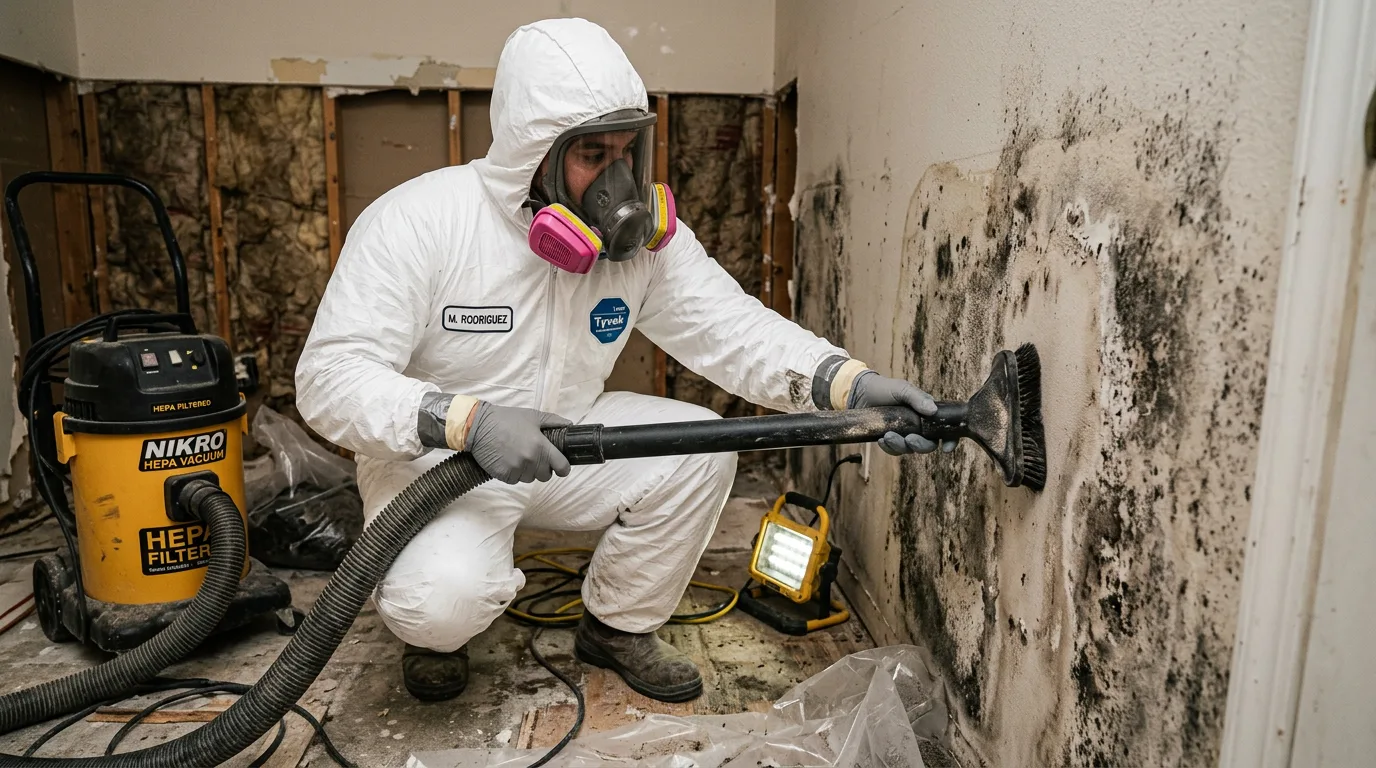
Is the musty smell in your Murray basement mold — or just damp concrete? Many homeowners ask this question after a water event, and the answer matters. Mold is not a cosmetic problem. It affects indoor air quality, can accelerate structural deterioration, and in many Utah insurance claims, is a covered consequence of the original water damage event. In this post, we cover when mold forms after water damage in Murray homes, what signs to look for, and the specific threshold at which professional mold remediation is required.
Mold After Water Damage in Murray? Free Inspection
Murray Water Damage Restoration provides IICRC-certified mold assessment throughout Salt Lake County. Call (877) 698-1311 for a free inspection.
Why Mold Grows So Quickly After Murray Water Events
Mold requires three conditions to grow: a food source (organic materials like drywall, wood, or paper facing), moisture content above approximately 60% relative humidity or material moisture content above 19%, and temperature above freezing. After a water damage event in Murray, all three conditions are simultaneously present in affected materials.
IICRC standards define the critical mold growth window as 24 to 48 hours after moisture exposure begins. This is not a worst-case scenario — it is the standard onset period under favorable conditions. In a Murray basement flooded in April, when outdoor temperatures are in the 50s and moisture content in affected wall assemblies is high, 24 hours is a realistic onset time. This is why water damage professionals describe water damage as a race against biology: the goal is not just to dry the water, but to dry it before the 24 to 48 hour threshold passes.
Murray’s spring wet season creates conditions that push homeowners toward mold risk in two specific ways. First, the volume and persistence of spring moisture events means some properties experience repeated or extended water exposure that extends well past the safe window. Second, homeowners who try to manage spring basement flooding with fans and towels rather than professional extraction often leave sufficient residual moisture in wall assemblies to support mold growth even after the surface appears dry.
Types of Mold Found After Water Damage
Cladosporium: One of the most common indoor molds following water damage. Appears as dark green, brown, or black powdery growth on walls, ceilings, and fabric surfaces. Typically found in Murray basements after spring flooding events.
Stachybotrys chartarum (black mold): The commonly referenced “toxic black mold.” Requires continuously wet materials for growth — it is more commonly found in areas with ongoing, chronic moisture rather than single flooding events. Appears as dark greenish-black slimy growth on cellulose materials (drywall, wood).
Penicillium/Aspergillus: These species grow quickly on water-damaged building materials and organic debris. Often appear as blue-green or white colonies on insulation, drywall, or stored items in water-damaged basements throughout the Murray Southeast and Atwood neighborhoods.
Chaetomium: A common secondary mold on water-damaged drywall and cardboard. Produces a distinctive musty odor. Often the mold causing the smell homeowners notice weeks after a water event that seemed to dry adequately.
Signs of Mold in Your Murray Home After a Water Event
- Visible growth: Any visible discoloration — black, green, white, gray, or orange — on walls, ceilings, floors, or stored items in the affected area warrants professional assessment.
- Musty odor: A persistent earthy or musty smell after a water event indicates active mold growth even if no visible mold is apparent. The odor comes from volatile organic compounds (VOCs) produced by actively growing mold colonies.
- Health symptoms: Respiratory irritation, sneezing, eye irritation, or headaches that improve when occupants leave the home can indicate mold exposure.
- Discoloration of paint or wallboard: Paint that is bubbling, discoloring, or peeling on interior walls following a water event may indicate mold growth beneath the surface.
- Warping or deterioration: Rapid deterioration of drywall, wood trim, or flooring materials beyond what water damage alone would explain suggests mold is actively decomposing the material.
When to Call a Professional for Mold Remediation
The EPA’s guidance uses 10 square feet as a rough threshold below which small mold patches may be manageable by a careful homeowner with appropriate PPE. Above that threshold, or in any situation involving HVAC contamination, visible structural framing, or suspected Stachybotrys growth, professional remediation is the appropriate response.
For Murray homeowners, professional mold remediation is strongly recommended whenever:
- Mold is present in a finished basement or living space (not just a concrete utility room)
- The water event that caused the mold was gray water (Category 2) or sewage (Category 3)
- Mold is visible on structural framing or inside wall cavities
- There is a reasonable possibility that HVAC systems circulated air through the affected zone during the mold growth period
- Any occupant of the home is immunocompromised, has respiratory conditions, or is under age 5 or over 65
Mold After Basement Flooding in Murray?
Our IICRC-certified team handles mold inspection and remediation throughout Salt Lake County. Call (877) 698-1311 — free inspection available.
How Professional Mold Remediation Works
Professional mold remediation follows IICRC S520 standards and involves four phases: moisture source correction, containment, physical removal, and post-clearance verification. The moisture source must be corrected first — remediating mold without fixing the underlying moisture condition guarantees recurrence.
Containment isolates the work area with plastic sheeting and negative air pressure to prevent spores from spreading to unaffected spaces. Physical removal includes HEPA vacuuming, wire brushing of non-porous surfaces, and complete removal and disposal of all porous materials that cannot be sanitized. Antifungal treatment is applied to all remediated surfaces.
Post-clearance air testing by an independent industrial hygienist confirms that spore counts have returned to background levels before containment is removed. This third-party verification distinguishes professional remediation from contractor self-certification.
Cost Factors
Mold remediation in Murray typically costs $500 to $6,000 for residential projects depending on the affected area size and materials involved. Small surface mold runs $500 to $1,500. Larger infestations affecting multiple walls, subfloor assemblies, or structural framing run $2,000 to $6,000 or more. Cases involving HVAC contamination cost more due to the additional duct cleaning scope.
Across Salt Lake County, the mold remediation projects we handle most frequently are post-spring-flood basement events where water was not professionally extracted and dried promptly. The typical delay between the water event and the mold discovery is 2 to 6 weeks — enough time for a small colony to become a large one. Most Utah homeowners insurance policies cover mold remediation when it resulted from a covered water damage event — we document the causal chain and work with your carrier directly.
Frequently Asked Questions
How do I know if I have mold or just damp concrete smell after Murray basement flooding?
Damp concrete has a mineral, earthy smell that typically decreases as the concrete dries over days. Mold produces a consistently musty, sometimes sweet odor that persists even after the surface appears dry, and often intensifies when the HVAC system runs. If you’re unsure, a professional air quality test or visual inspection with borescope can definitively confirm whether mold is present. Don’t guess on this — mold identification is straightforward with professional equipment.
Can I use bleach to kill mold in my Murray basement myself?
Bleach kills surface mold on non-porous materials (concrete, tile) but does not penetrate porous materials (drywall, wood, insulation) to kill mold growing inside them. Surface bleach treatment on porous materials creates the appearance of removal while leaving the mold colony intact below the surface. For any mold on drywall, wood framing, or insulation, complete physical removal of the affected material is the only reliable remediation approach. For more information see our mold remediation service page.
Will my Utah homeowners insurance cover mold after water damage?
It depends on the cause. If the mold resulted from a covered water damage event (burst pipe, storm damage, appliance failure), mold remediation costs are often covered as a consequence of the original covered event. If the mold resulted from gradual moisture accumulation or deferred maintenance, it is typically excluded. Document the connection between the water damage event and the mold discovery — this documentation is critical for claim support.
Mold Remediation in Murray — IICRC Certified
Murray Water Damage Restoration provides complete mold inspection and remediation throughout Murray and Salt Lake County. Call (877) 698-1311.
Related: