7 Signs of Hidden Water Damage in Your Murray Home
Your Murray basement smells musty, but you don’t see any water. A section of drywall feels slightly soft, but there’s no discoloration. Your utility bills went up, but you haven’t changed your habits. These are the subtle presentations of hidden water damage — damage that is happening inside walls, under flooring, and above ceilings without any visible surface evidence. By the time many Murray homeowners discover this type of damage, mold has already colonized and structural materials have been compromised for weeks or months. Here are the seven signs to watch for.
Suspect Hidden Water Damage in Your Murray Home?
Murray Water Damage Restoration offers free assessments with moisture meters and thermal imaging throughout Salt Lake County. Call (877) 698-1311.
Why Hidden Water Damage Is Particularly Common in Murray
Murray’s housing stock includes a substantial number of mid-century homes where water damage has occurred repeatedly over decades. Each event that went undetected or was only partially remediated leaves a layer of previously wet — and potentially mold-colonized — material inside wall assemblies. Over time, the sum of these events creates conditions where new moisture events are not recognized because the home already has a baseline of moisture-related deterioration that owners attribute to “old house smell” rather than active damage.
Murray’s spring wet season also creates ideal conditions for slow, progressive infiltration that doesn’t announce itself as a dramatic flooding event. Water that seeps through a hairline foundation crack in Murray Southeast or along a compromised window frame in Murray East may wet insulation and wall framing for weeks before producing any visible surface indicator. During that time, mold colonies are growing and structural drying becomes progressively more complex.
Sign 1: Musty or Earthy Odor Without Visible Mold
A musty smell that persists in a Murray basement or living area — especially one that intensifies when the HVAC system runs — is a reliable indicator of active mold growth even when no visible mold is present. Mold produces volatile organic compounds as a metabolic byproduct; these compounds create the recognizable odor long before colonies are large enough to see with the naked eye. Don’t dismiss this sign as “old basement smell” — have it assessed professionally before the next spring wet season amplifies it.
Sign 2: Unexplained Increase in Water Bills
If your Murray household’s water consumption has increased without a corresponding change in usage habits, a slow plumbing leak is the most likely explanation. A leaking supply line inside a wall releases a fraction of the flow that a burst pipe produces, making it easy to miss — but a slow drip running continuously over weeks can saturate a wall assembly completely. Check your water meter readings over 24 hours with all fixtures off to detect any unexplained flow.
Sign 3: Soft, Spongy, or Warping Floor Areas
Hardwood and laminate flooring absorb moisture from below when subfloor materials are wet. The result is subtle but progressive: boards that feel slightly soft underfoot, floor areas that spring more than adjacent sections, or visible cupping or gapping between floorboards. In Murray homes with basements or crawl spaces, this symptom typically indicates moisture originating from below-grade rather than from above-floor spills.
Sign 4: Peeling or Bubbling Paint on Walls or Ceilings
Paint lifts from its substrate when moisture is present behind the painted surface. Peeling or bubbling paint on walls adjacent to exterior foundations — particularly on the north and east-facing walls of Murray homes where winter cold penetrates most — is a common indicator of moisture migrating through the wall assembly from outside. On ceilings, this symptom often indicates a roof leak above, particularly in Murray homes after winter ice dam formation.
Sign 5: Rust Stains or Efflorescence on Basement Walls
Rust-colored staining around basement wall penetrations (pipes, conduits, window frames) indicates water has been tracking down these pathways from outside. White or gray mineral deposits (efflorescence) on concrete or block walls indicate water has been moving through the masonry under pressure, depositing dissolved salts as it evaporates. Both are reliable indicators of ongoing moisture infiltration rather than a single past event.
Sign 6: Warped, Stained, or Sagging Drywall
Drywall absorbs moisture and begins to warp or sag under sustained wetness. A drywall section that has lost its flat plane — bowed slightly inward or outward, or sagging at a horizontal seam — has almost certainly been wet. Grayish or yellowish staining on drywall without obvious explanation (no visible spill, no visible plumbing above) indicates moisture tracked down from above or absorbed from behind.
Sign 7: Mold Visible at Baseboards or Trim
Mold appearing at the base of drywall, along floor trim, or at the corners of rooms near exterior walls indicates moisture is present at the floor-wall junction or is wicking up from below-grade sources. This location is consistent with the slow seepage patterns common in Murray’s older homes when clay soil pressure drives water through the wall-floor joint. If mold is visible at trim level, there is almost certainly more mold behind the wall at higher levels where it hasn’t yet become visible.
7 Signs Checked — Found One in Your Murray Home?
Murray Water Damage Restoration provides thermal imaging and moisture assessment throughout Salt Lake County. Free inspection available. Call (877) 698-1311.
What to Do When You Find Signs of Hidden Water Damage
The first step after identifying any of the signs above is professional moisture assessment — not immediate demolition or DIY remediation. Using moisture meters and thermal imaging, a certified technician can map the extent of affected materials, identify the moisture source, and determine whether mold remediation is needed before reconstruction. This assessment determines the project scope and cost, and provides documentation for insurance claims.
Do not paint over stained drywall or caulk over efflorescence without addressing the moisture source. Surface treatments mask symptoms and delay the discovery of ongoing damage, which continues to worsen underneath. Murray’s spring wet season will bring the same moisture pressure back to an unsolved drainage or waterproofing problem every year until it is corrected.
If the assessment reveals mold growth inside wall assemblies, professional mold remediation is required before reconstruction can begin. Rebuilding over undocumented mold creates indoor air quality problems and can make future insurance claims significantly more complicated.
Cost Factors
Hidden water damage, by definition, is often discovered at a more advanced stage than acute flooding events. The damage has been progressing for weeks or months rather than hours. This typically means larger affected areas, established mold colonies rather than early-stage growth, and more compromised structural materials. Budget accordingly: hidden water damage restoration in Murray often costs more than the $1,383 to $6,378 range for standard visible flooding events across Salt Lake County, particularly when mold remediation and structural framing replacement are involved.
Early detection is the cost-control lever. A professional moisture survey in a Murray home that shows signs of hidden damage — even one as subtle as a musty odor — costs several hundred dollars and can identify a problem while it is still contained. Waiting until the evidence becomes unmistakable routinely multiplies the remediation scope.
Frequently Asked Questions
How do I test for hidden water damage in my Murray home without opening walls?
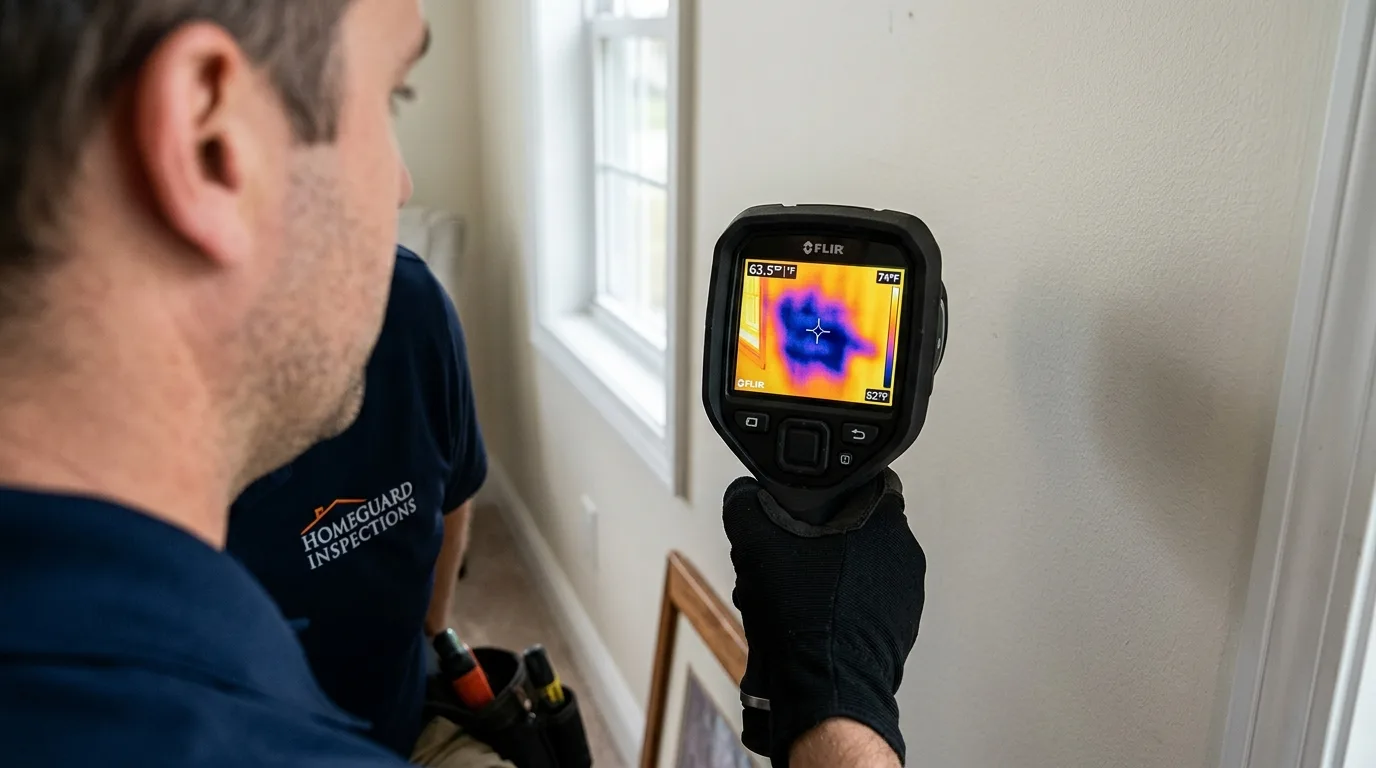
Thermal imaging cameras detect temperature differentials that indicate moisture inside wall assemblies without any demolition. Moisture meters measure material moisture content through wall surfaces using pin or non-invasive probes. Both are standard tools used by IICRC-certified restoration technicians during the scope assessment phase. We perform these assessments for Murray homeowners throughout Salt Lake County — call for a free inspection if you suspect hidden damage.
Can hidden water damage inside walls dry on its own in Murray’s dry climate?
Murray’s dry climate — averaging just 16 to 18 inches of annual precipitation — does allow some drying of lightly affected materials without intervention. However, materials inside a finished wall assembly have minimal airflow for evaporation, and the clay soils that maintain moisture pressure against Murray’s foundations continue to introduce new moisture even as the interior slowly tries to dry. Wet materials inside finished walls rarely self-dry adequately, and mold growth typically establishes before drying is complete without professional intervention.
Should I buy a home in Murray with visible signs of past water damage?
It depends on the documentation. If the seller can provide professional moisture clearance documentation showing all affected materials were properly dried and remediated by an IICRC-certified company, the risk is manageable. Without that documentation, you have no way to know whether the prior damage was professionally dried or simply dried in place — leaving the potential for mold colonies and compromised structural materials inside the wall assembly. A pre-purchase moisture inspection by a certified inspector is a valuable investment for any Murray home with visible signs of past water events.
Hidden Water Damage Assessment in Murray — Free Inspection
Murray Water Damage Restoration uses thermal imaging and moisture meters to find hidden damage throughout Murray and Salt Lake County. Call (877) 698-1311.
Related: