Clay Soil Foundation Damage in Murray, UT: 5 Warning Signs
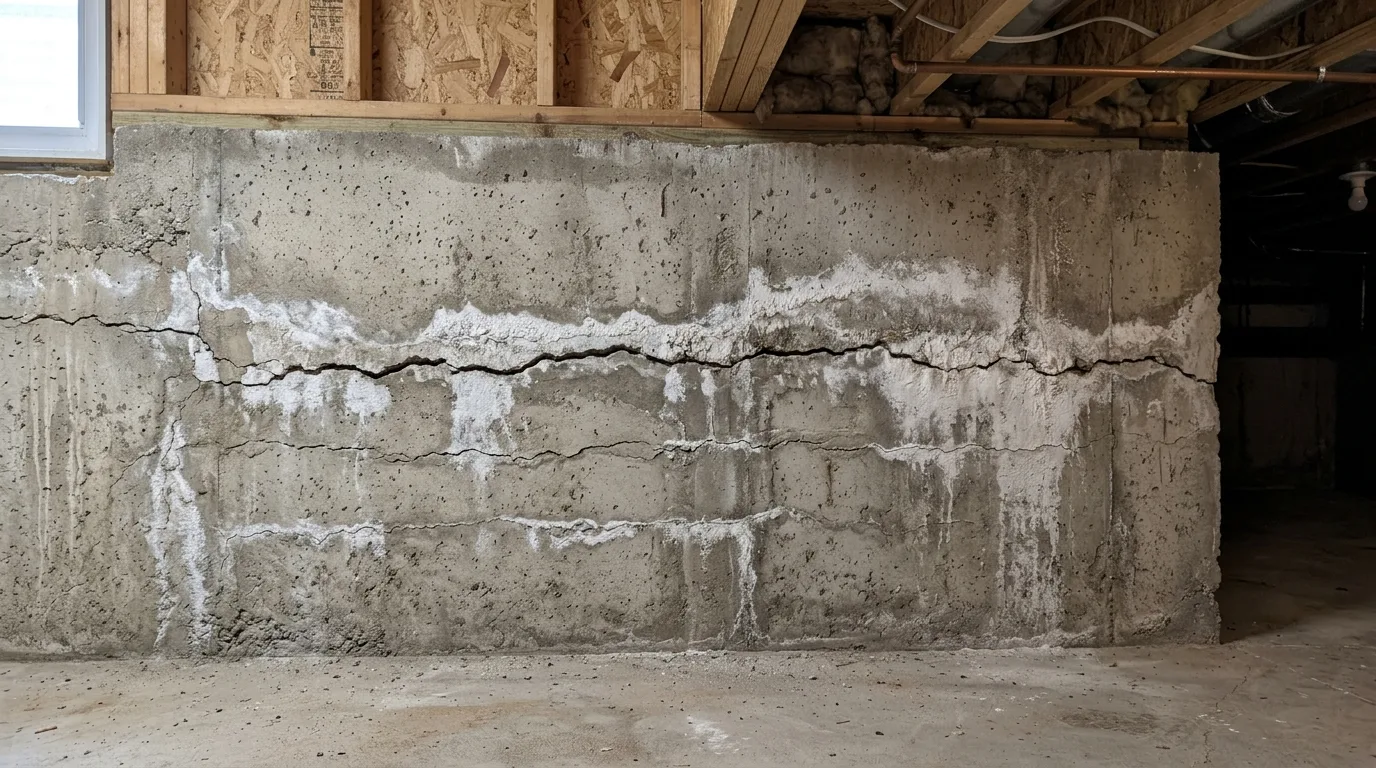
Is the water in your Murray basement coming from the walls rather than the floor? Many homeowners in Salt Lake County assume basement water intrusion is a random event — bad luck or unusual weather. In reality, it’s often the predictable result of Murray’s expansive clay soils behaving exactly as they always have, and the foundation not keeping up. In this post, we explain what expansive clay does to Murray foundations, identify five warning signs that soil pressure is driving water damage into your home, and cover what to do when you see them.
Water Through Your Murray Foundation Walls?
Our team assesses clay soil-driven basement flooding throughout Salt Lake County. Call (877) 698-1311 for a free assessment.
Why Murray’s Clay Soils Drive Basement Water Damage
Salt Lake Valley soils are dominated by expansive clays — minerals that absorb water and swell in volume, then shrink and crack during dry periods. This behavior puts seasonal stress on any structure with a below-grade footprint. During Murray’s wet season from March through May, clay soils surrounding foundation walls absorb moisture from snowmelt and spring rain, increasing in volume and pressing against basement walls with what engineers call hydrostatic pressure. The same soils that seem harmless in dry summers become a structural force in a wet spring.
The “clay bowl effect” is particularly relevant for Murray homeowners. When a home is built, the soil immediately adjacent to the foundation is excavated and then backfilled with the same or similar material. This backfill soil is looser and more porous than the undisturbed native clay — it absorbs more water and retains it longer. The result is a zone of persistently elevated moisture content right against your foundation walls, even when soils further away from the house have drained. In neighborhoods like Murray Southeast and City Center where homes were built from the 1950s through the 1970s, original waterproofing systems are often no longer adequate to resist the pressure this clay bowl generates.
5 Signs of Clay Soil Damage to Your Murray Foundation
Sign 1 — Horizontal cracks in basement walls: Horizontal cracks are the most serious foundation warning sign. They indicate lateral pressure — soil pushing inward from outside the wall. The clay soils throughout Salt Lake County generate significant lateral pressure during saturated conditions, and horizontal cracks are the visible result of that force exceeding the wall’s resistance capacity. If you see horizontal cracks in your Murray basement, especially if they’re widening over successive springs, have the wall assessed by a structural engineer.
Sign 2 — Wall bowing or bulging: Before horizontal cracks appear, you may notice that basement walls are no longer plumb — they have a slight inward bow, typically at mid-height where lateral pressure is greatest. Hold a level or straight board against the wall and check for a gap at the center. Any inward displacement beyond 1/4 inch warrants professional assessment.
Sign 3 — Efflorescence (white mineral deposits): White or gray powdery deposits on basement walls are called efflorescence — mineral salts left behind when water evaporates after passing through concrete or block. Efflorescence means water has been moving through your foundation wall, even if no standing water is currently visible. It’s a common finding in older Murray homes after spring wet seasons and indicates ongoing moisture migration under pressure.
Sign 4 — Seeping water at the wall-floor joint: The joint where the basement wall meets the floor slab is a common entry point for hydrostatic water because it is structurally the most vulnerable point of the below-grade envelope. Persistent seeping at this joint — especially increasing after rain events — indicates that water pressure is sufficient to push through the joint rather than being drained away by the foundation drainage system.
Sign 5 — Recurring basement flooding that tracks with rain events: If your basement flooding is clearly correlated with wet weather — appearing during spring rain events and receding after dry periods — clay soil hydrostatic pressure is almost certainly the driver. This pattern is distinct from plumbing failures (which are not weather-correlated) and indicates a soil drainage problem rather than a one-time event.
Practical Uses: What to Do About Each Warning Sign
-
Horizontal cracks: Engage a structural engineer for assessment. Depending on displacement, repair options range from carbon fiber strap reinforcement (less invasive) to helical wall anchors or full wall replacement (more invasive). Document the cracks with photos dated monthly to track progression rate.
-
Efflorescence: Efflorescence itself is cosmetic, but the water movement causing it is not. Address the source — typically a drainage system that is no longer directing water away from the foundation — rather than just cleaning the surface deposit. Interior drain tile installation can intercept water before it builds pressure against the wall.
-
Wall-floor joint seeping: Apply hydraulic cement to the joint as a temporary measure, then address the underlying drainage issue. Perimeter interior drain tiles that channel water to the sump pit are the standard long-term solution for Murray homes with chronic joint seeping.
-
Recurring weather-correlated flooding: Have a waterproofing contractor evaluate both exterior drainage and interior waterproofing options. Murray’s clay soils cannot be changed, but water can be redirected before it builds pressure — through improved exterior grading, extended downspouts, and functional French drain systems.
How Clay Soil Pressure Causes Water Damage
Basement Water from Your Foundation Walls?
Murray Water Damage Restoration handles flood cleanup and can recommend waterproofing contractors throughout Salt Lake County. Call (877) 698-1311.
The seasonal pressure cycle in Murray follows a predictable pattern. From November through March, freeze-thaw cycling moves water in and out of clay particles repeatedly, creating micro-fractures in soil and foundation materials alike. By the time spring precipitation begins in March, the soil’s structure has been weakened by repeated thermal cycling, making it more prone to absorbing and holding water than it would be earlier in the year.
When spring rain and snowmelt arrive, saturated clay soils press against foundation walls with increasing force as moisture content rises. The structural drying that occurs during summer and early fall provides only temporary relief — the clay shrinks back but does not stop retaining water against the foundation. For Murray homes without adequate exterior waterproofing or interior drainage, this annual cycle progressively damages foundation assemblies over decades.
Understanding this mechanism matters when assessing a water damage event: if clay soil pressure is the cause, drying out the basement once is not a solution — it’s a temporary repair. The underlying drainage condition must be addressed to prevent recurrence.
Cost Factors
Structural foundation repairs driven by clay soil pressure in Murray typically cost $3,000 to $15,000 depending on the scope. Carbon fiber wall straps run $4,000 to $8,000 for a full wall treatment. Interior drain tile installation with sump pump runs $5,000 to $12,000 for a full basement perimeter. These are separate from the water damage restoration costs — $1,383 to $6,378 for a standard flooding event in Salt Lake County — which are needed to address the damage already done.
In older Murray neighborhoods where clay soil pressure has been acting on foundations for 50 or more years without drainage correction, repair costs may be at the high end of the range. Homeowners insurance typically does not cover foundation repair driven by soil pressure, though it may cover the water damage that resulted from foundation seepage on a case-by-case basis.
Frequently Asked Questions
Is foundation damage from clay soils covered by homeowners insurance in Utah?
Generally, no. Structural damage caused by soil pressure is considered a maintenance issue rather than a sudden and accidental event, and most Utah homeowners policies exclude it. Water damage that entered through a foundation crack or joint may be covered on a case-by-case basis depending on your policy language. Document flooding events professionally to support any claim you do make. For insurance coverage questions, read our guide on homeowners insurance and water damage in Utah.
How do I know if soil pressure or plumbing is causing my basement water?
Soil pressure intrusion is weather-correlated — it appears after rain or snowmelt events and is typically visible as seeping water at foundation walls or the wall-floor joint. Plumbing failures are not weather-correlated and often appear suddenly with larger volumes of water from a specific location. Clay soil intrusion tends to be a slow seep; plumbing failures tend to be fast and localized. If you’re unsure, call a water damage professional to assess the source before proceeding with any repairs.
Can I stop clay soil water intrusion from the inside?
Interior waterproofing (drain tiles, wall panels, sump pumps) redirects water that makes it through the foundation rather than stopping it at the exterior. It is effective for managing moisture and preventing standing water but does not reduce the pressure on the wall itself. For structural concerns — horizontal cracks, wall bowing — interior waterproofing addresses symptom management; exterior drainage and structural repairs address the cause.
Clay Soil Flooding in Murray — We Can Help
Murray Water Damage Restoration — basement flood cleanup and soil pressure damage response throughout Murray and Salt Lake County. Call (877) 698-1311.
Related: