Prepare Your Murray Home for Spring Runoff: A Homeowner's Guide
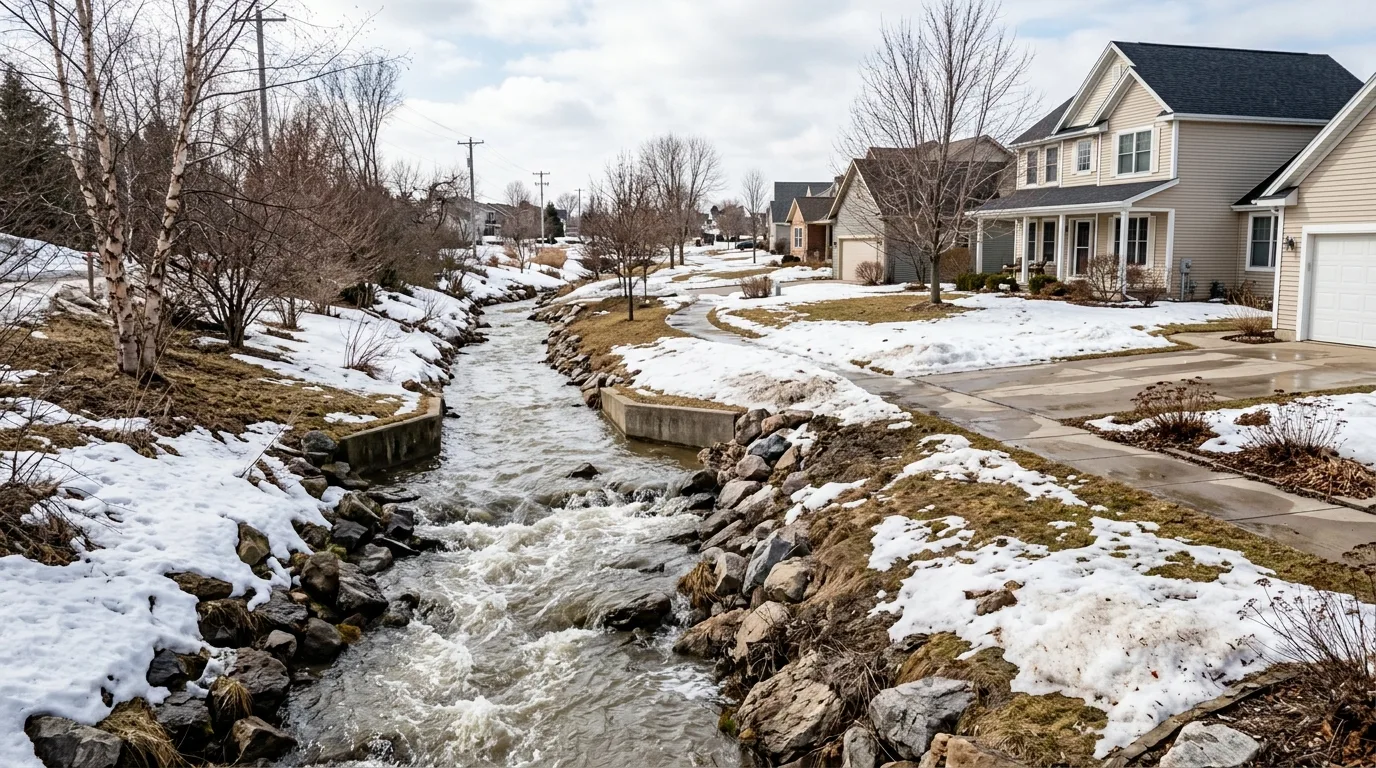
Murray homeowners who complete their spring preparation checklist by late February return to dry basements in April. Those who don’t often call us in March. The difference is rarely luck — it’s the specific steps taken before the snowmelt begins that determine whether your basement stays dry when the soil around it becomes saturated. Here’s what to do, in order, to give your Murray home the best chance of a dry spring.
Spring Prep Complete — But Still Flooded?
Murray Water Damage Restoration handles spring flood cleanup throughout Salt Lake County. Call (877) 698-1311 for 24/7 emergency response.
Why Spring Runoff Is Murray’s Biggest Water Damage Season
When Murray homeowners in the Murray Southeast and Murray East neighborhoods see water in their basements each spring, it is not random bad luck. The Salt Lake Valley’s topography, soil composition, and precipitation calendar combine to create conditions that are reliably most stressful on residential foundations from March through May of every year.
The Wasatch Range to the east of Murray accumulates snowpack from November through February. As temperatures rise in late February and March, that snowpack begins melting and flowing down into the valley. By the time April’s rain events arrive — the month with the highest average precipitation in the valley — the clay-heavy soils throughout Salt Lake County are already fully saturated from weeks of snowmelt. Water table levels are at their annual peak. Hydrostatic pressure against basement walls is at its maximum. And every rain event deposits water on soil that cannot absorb it, forcing it to run off and find any available entry point into below-grade structures.
Understanding this cycle — not as a random event but as a predictable annual pattern — is what makes effective preparation possible.
Types of Spring Runoff Threats to Murray Homes
Hydrostatic pressure seepage: Saturated clay soils press water against foundation walls from outside. Water infiltrates through hairline cracks, the wall-floor joint, and any point where the foundation envelope is compromised.
Surface water flooding: Runoff from streets, driveways, and neighboring properties concentrates near your home’s lowest drainage points. Short or improperly graded downspouts deposit water directly against the foundation.
Window well flooding: Shallow window wells without drainage covers accumulate snowmelt and rainwater until they overflow into the basement window frames.
Sump system overload: A sump pump running continuously during peak runoff may reach its capacity limits. Power outages during spring storms — common throughout Salt Lake County — can take down an otherwise functional sump system at exactly the wrong moment.
Practical Spring Preparation Checklist for Murray Homeowners
-
Test the sump pump in late February: Fill the sump pit with water from a garden hose and verify the float switch activates the pump promptly. If the pump runs slowly, makes unusual noise, or takes more than a few seconds to respond, service it before March. Consider a backup battery unit that activates during power outages — a single spring storm power outage can defeat an otherwise properly functioning primary pump.
-
Install window well covers on all below-grade windows: Plastic bubble-style window well covers prevent accumulation of snow and rain in window wells. They are inexpensive ($30 to $80 each) and install in minutes. Murray homes built before 1980 often have window wells without covers — install them before the season.
-
Extend all downspouts to discharge at least 6 feet from the foundation: This is consistently the highest-return improvement Murray homeowners can make for the lowest cost. Downspouts that terminate within 1 to 2 feet of the house deposit concentrated runoff directly at the foundation. Flexible downspout extensions cost $15 to $25 each and require no tools to install.
-
Clear gutters of debris from fall and winter: Blocked gutters overflow along the full length of the roof eave, depositing concentrated water against the foundation at multiple points. Clear gutters in early March before the major melt begins.
-
Inspect and seal visible foundation cracks: Walk the basement perimeter and mark any new cracks that appeared over winter. Freeze-thaw cycling during November through February creates new micro-fractures each winter. Seal with hydraulic cement before the spring wet season begins.
-
Verify proper grading adjacent to the foundation: Soil around the perimeter of your Murray home should slope away from the foundation. If settling has created flat or inward-sloping areas, add topsoil to restore positive drainage before the ground thaws.
-
Locate and test the main water shutoff: While you’re in the utility room testing the sump pump, confirm the main water shutoff valve operates correctly. A valve that is rarely used may be stiff or partially corroded — better to discover this in February than during a burst pipe emergency in January.
How a Dry Spring Season Protects Your Investment
Spring Flooding Despite Preparation? We Respond 24/7
Murray Water Damage Restoration handles spring flood cleanup throughout Murray and Salt Lake County. Call (877) 698-1311 anytime.
Preparation does more than prevent a single year’s flooding — it protects the long-term structural integrity of your Murray home. Each spring flooding event that causes water to enter your basement accelerates the deterioration of existing waterproofing, introduces new moisture to materials that gradually degrade with repeated cycles, and creates new pathways that make the next event easier for water to enter.
Homeowners in the older Murray neighborhoods near City Center and Murray Park who have experienced multiple basement flooding events typically show more extensive foundation deterioration than comparable homes that have been kept dry through active drainage maintenance. The cumulative effect of repeated moisture cycling through concrete and block foundations — expanding when wet, contracting when dry — progressively weakens the masonry over years.
Spring preparation is an investment in stopping that cycle, not just in surviving one season.
Cost Factors
Spring preparation costs for a typical Murray home run $200 to $600 for the items described above: sump pump testing and battery backup ($150 to $300), window well covers ($30 to $80 each for 2 to 3 wells), downspout extensions ($15 to $25 each), and crack sealing ($50 to $150 for materials). These are annual or one-time investments.
A single spring flooding event in Murray costs $1,383 to $6,378 to remediate professionally across Salt Lake County — and that is for a standard event without sewage contamination or major structural involvement. Prevention investment at $200 to $600 per year is simply good property math.
If previous spring flooding events suggest that your home has a more significant drainage problem than maintenance items can address, interior drain tile installation and sump capacity upgrades run $5,000 to $12,000 — but permanently address chronic spring flooding patterns common in Murray’s clay-soil neighborhoods.
Frequently Asked Questions
When should I start spring flood preparation in Murray?
Complete your preparation checklist by February 28. The Wasatch snowmelt begins gradually in March and accelerates through April. Having all drainage maintenance, crack sealing, and equipment testing done before the major melt begins ensures you’re ready when the pressure on your foundation peaks in late March and April.
How do I know if my sump pump has enough capacity for Murray’s spring runoff?
A properly functioning sump pump should cycle on and off during a typical spring rain event, not run continuously without keeping up with inflow. If your sump pump runs without cycling off during a moderate rain event, the capacity may be insufficient for your home’s drainage load. A plumber can assess whether a higher-capacity pump is needed and estimate inflow rates based on your drainage area.
What should I do if my basement floods despite preparation?
Call Murray Water Damage Restoration immediately at (877) 698-1311. Even if you prepared thoroughly, some spring events exceed what any home drainage system can manage during peak snowmelt. Fast extraction limits total damage significantly — every hour of delay allows water to wick further into walls, flooring, and structural materials. Read our full guide on flood cleanup in Murray for what to expect from the restoration process.
Murray Spring Flood Prep — And Emergency Backup When Needed
Murray Water Damage Restoration handles spring flood cleanup throughout Murray, Taylorsville, Sandy, Millcreek, and Salt Lake County. Call (877) 698-1311.
Related: